
Wyatt McCord’s Last Day on Earth
STORIES
By donalee Moulton
2/13/2026
Wyatt McCord is dripping all over the hotel room. A trail of water follows him from the beige bathroom across the beige carpet. A towel covers his rear. It’s beige. Wyatt likes beige.
Wyatt does not like this towel. It’s soft enough, Wyatt thinks, but it is not doing what it was deigned to do: absorb moisture. That annoys Wyatt.
He removes the towel and walks naked to his phone, which is vibrating its way through a drum solo. That’s Wyatt’s alarm, and it is unnecessary. On concert days, Wyatt is always up before his technology. It’s less about tending to a checklist of chores, although there is that. No, it’s anticipation and apprehension. For Wyatt McCord, the two are synonymous when he is about to go on stage.
After the drum solo is silenced, Wyatt hears a noise outside his door. Room service is right on time. Wyatt knows the eggs will be cold, the toast will be burnt, and the bacon will be soggy. He knows the tray will be beige. It doesn’t matter. Wyatt McCord is not hungry. This is about tradition. About not annoying the concert gods. Those djinn that live inside convention centers, amphitheaters, and arenas.
It's not that Wyatt McCord is superstitious. It’s that he’s forty-three, and he has been writing and singing songs for more than half his life. He has performed on stages when all of the microphones refused to work, the drunk guy in the third row puked his guts over the lovely lady in the second row, the fire department showed up ‘cause some idiot pulled an alarm, the fire department showed up ‘cause there was a fire. No djinns are real, and Wyatt McCord isn’t taking any chances.
The way to ensure the djinn don’t make an appearance: preparation (and a pastrami on rye left alongside a cold beer stage left). It’s just seven in the morning and Wyatt is ready. He’s air dried, he’s dressed, he’s on his way out the beige hotel door.
There is one lone janitor in the London Music Hall. He does not believe in djinn. He knows that performers do. He’s not surprised to hear Wyatt knocking at the stage door. He is surprised by the coffee and donuts Wyatt has brought him. This is not Wyatt appeasing the djinn. This is simply Wyatt. Wyatt McCord is a nice guy. The janitor wonders if djinn like nice guys.
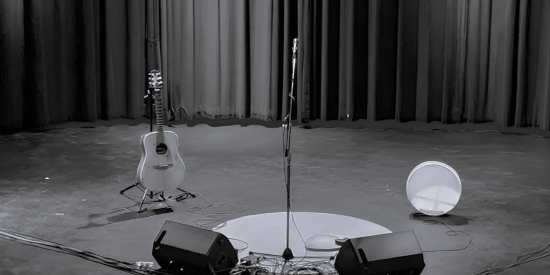
It takes about two hours for Wyatt to set the stage. By the time the band arrives, six guitar stands are in position. Two of them hold guitars. Three mics cluster in a semi-circle. Wyatt is surveying his work, work he knows the roadies could have done, but this is his process.
As the band files in with more food and coffee, Wyatt steps outside to call Molly. He does this every morning he is on the road. Wyatt makes a lot of calls to Molly. She’s used to her husband being away from home, doesn’t love it, doesn’t hate it. She does like the first call of the morning.
No issues. Wyatt breathes a little easier. It’s not like he expects the world to fall apart because he’s not home, but there is little he can do when he’s more than nine hundred miles away from his front door.
“Kids are fine,” Molly says. “Eager to see you tomorrow.”
“I can’t wait to see them. And you,” Wyatt says. He means it. There is nothing like being on the road. There is nothing like getting off the road.
“The sink in the bathroom won’t drain.”
A hiccup. Not an issue. Wyatt can deal with this when he gets home. Molly agrees. No need to call a plumber. Wyatt actually likes to tackle jobs like this. He thinks if he hadn’t become a musician, he would have been a plumber. Wyatt McCord smiles. It’s a good day.
***
The guys are doing guy stuff: snorting, scratching, guffawing. It’s pent-up energy. Everyone is counting down. Last show of the tour. Home waits, and everything that means. But Wyatt is not fooled by the antics or the sounds that emanate from his band. They are professionals, and when they walk on stage tonight, the songs will be rehearsed, the sound triple checked, and the voices primed.
It’s tradition to eat supper around three. Sounds early, but it gives the food time to digest. (No belching on stage.) It also helps to pass the remaining minutes until feet hit the floorboards. Fact is, by now there’s little to do but wait for the curtain call. Wyatt will change his clothes, but you’d never know it. A different set of blue jeans, a different t-shirt. He thinks about wearing a hat. He always thinks about wearing a hat – baseball, cowboy, miki. He always decides not to wear a hat. Today is no different.
Wyatt is looking forward to the early supper. For reasons he can’t explain, he’s prancing. There is energy coming out his feet, his hands. He finds himself moving when there is no need to move. His vocal coach would call this pre-show jitters. She would be wrong. Wyatt knows what he is: a damn good songwriter, a fine musician, an even finer performer. Sure, he’s no Taylor Swift. He’ll draw about 1,900 people tonight. She drew about 70,000 per show on the Eras tour. Still, she gets on stage, opens her mouth, and music comes out. Wyatt will do the same, like he’s always done.
Wyatt has an ability to connect with his audience. That connection can’t happen though until he walks across the tempered hardwood and the applause erupts. He’s earned that applause. He writes hard. He sings hard. Tonight, he’ll prance hard.
Judd is regaling the crew with a story about a fan who tried to sneak into a concert. There’s something about flowers and a tip. Wyatt isn’t really listening. He usually doesn’t. He goes somewhere about this time; he’s not sure where. He can hear the guys. He smiles when it’s time to smile, and adds the odd anecdote of his own, but Wyatt is already on stage. He sees the crowd as he walks out, he feels the blood in his bones, he hears his opening joke and waits for the laughter he knows will come. Wyatt McCord is ready.
“I have to fix a clogged drain.” Wyatt feels the eyes of everyone at the table. “Well, you asked what we were looking forward to.”
“Man, you have to get out more,” says Judd but he grins. Wyatt’s best friend and bass player has drains of his own waiting at home.
***
It’s time. As Judd would say with his ever-present grin, “The end is nigh.” For Wyatt, the end of the tour starts like every other night of the tour. With a call to Molly. The guys get a kick out of this. There are a lot of jokes about balls and chains. Wyatt takes it in stride. He wants to virtually hug his kids goodnight, but mostly he wants to talk with his wife. He knows this is overcompensation. When you are on the road as much as he is, it’s easy to remove yourself from the responsibilities of daily living. When you are a performer like he is, when the audience is hootin’ and hollerin’, it’s easy to forget you are a mere mortal.
Wyatt needs to atone. Hence calls home at least twice a day. There is nothing subtle about Wyatt’s motivation, but now there is an added element. Wyatt is apologizing. Again. Before he goes on the road, he likes to get the house in order and make things easy for Molly. Sometimes he forgets to tell her how helpful he has been. Last tour he went to Best Buy and picked up a portable phone set with five extensions, so no matter where Molly was in the hose, she would be within easy reach of a receiver. Except Wyatt forgot to tell her about the phones. There are reasons for this, of course. Molly was at work, Wyatt was packing, the kids were rushing in from school for a final goodbye.
Apparently Wyatt also forgot to tell his wife about one of the phone system’s special features: it announces the name of the caller. At least, a partial name of the caller. Molly discovered this when she was midway up a ladder in the guest bedroom painting the accent wall yellow. In the quiet of the afternoon, a voice rang out. Jesus Christ is calling.
Jesus was not calling. A local church looking for clothing donations was. Too late. Molly jerked back and stumbled off the ladder, yellow paint poured over the tarp and made a beeline for the oak hardwood floor. The paint that didn’t land on the floor landed on Molly.
Hence, the need for an apology. Again.
***
The crowd is right where Wyatt expected them to be. On their feet. He walks easily on to the stage, pauses, waves. The crowd thunders in response. This is smart business. Pump up the audience; sell more merch. But for Wyatt, it is about more than selling merch. There is a connection here when he is singing and the audience is hearing what he has to say. Wyatt doesn’t want to romanticize this connection. It simply is. And when Wyatt is being completely honest with himself, performing is also about selling merch.
Wyatt has accepted who he is onstage and off. He knows he will not be the next Zach Bryan. Or Jason Aldean. Wyatt is mid-tier. Wyatt is comfortable here. He is content to live on the periphery of the dream. He is content to stand apart. A little bit country, a little bit folk, a little bit plumber.
Stages are contained spaces, and they are dangerous spaces. Mics, cords, cables, stands, connectors all pose tripping, tumbling, electrical hazards. The edge of the stage is always within easy reach. It’s about twenty feet from back to front. You can cover that distance in seconds when you are moving at the speed of an electric guitar. It’s safest to stay in one spot. Then there are the lights. Blinding. So we have a sightline, a narrow band where the PAR can lights don’t reach, where a person in the audience looks like a person and not an apparition.
Wyatt’s clearest sightline is about four rows back, the aisle seat and the one next to it. It’s not much, but it is enough to ground him. You look out and someone real looks back. Wyatt will glance throughout the audience during the concert, but only these two people will be fully formed.
The woman in the aisle seat seems familiar. Wyatt feels he has met her before, but he does not recognize her, the long-haired brunette with the denim skirt, knee-length plether boots, fringe jacket, and blue leather gloves. The disconnect is not unusual. She may be a regular, even a superfan. He may have talked to her backstage at a meet and greet. Still Wyatt prides himself on knowing his base.
He does know the woman in the seat beside her, not by name but by personality. In the shadow of the red floodlight, she has a pink glow. Wyatt is reminded of Bazooka bubble gum. Suddenly his mouth is dry.
The opening set goes off without a hitch. Wyatt pushes the new merch before the band exits backstage. It should be a good last night. He’s tempted to call Molly. To ask about the clogged drain, but he knows this is overkill. He also knows this is not about plumbing problems. It’s about absence and no way around it. Even Jesus Christ calling can’t change that.
So Wyatt has a beer. He goes to the bathroom. He fixes his hair. He tells Judd about Bazooka. He gets the laugh he expected. He asks Judd if he recognizes the lady in aisle four. Judd peeks out the stage curtain and shakes his head no. Wyatt takes another look. Still nothing but a nagging feeling he should know this woman.
Bazooka is back in her seat sporting a new denim jacket with Wyatt McCord spilled out in glitter across the back. She shows it off to people in front of her, behind her. It’s going to be a good night for merch. Wyatt smiles.
And the band is back on stage. Everyone on the floorboards and in the audience is pumped. Endings do that. It’s not just the end of the concert; it’s the end of the tour. Wyatt gives it everything he’s got, and he’s got a lot.
Wyatt launches into a dance tune inspired by Johnny Cash’s Ring of Fire. The audience is on their feet. Right where he wants them. They’re clapping, and singing, and hooting. Right what he wants them to do.
Three songs to go. Then it’s homeward bound. To Molly. To the little ones. To the clogged drain. Wyatt looks through his sightline. Bazooka is bouncing, a grin from ear to ear. He sees her turn her head. Her mouth forms an O. Wyatt expects to see a pink bubble. He sees something in the hand of the woman he knows he should know. Something grey. Something angular. Something with a barrel. Before he gets to the final verse of the song that started off as someone else’s, he knows what the woman is holding.
Wyatt’s life does not flash before his eyes. He does not itemize regrets. He does not ask for forgiveness. He doesn’t even appreciate the irony. Jesus Christ is calling. As the 9mm bullet severs his aorta, Wyatt McCord exhales his last syllable. He hits the floor with a thud no one can hear over the noise of the band. He never feels the singular drop of water from the overhead pipes.
BIO: donalee Moulton’s first mystery book Hung out to Die was published in 2023. A historical mystery, Conflagration!, was published in 2024. It won the 2024 Daphne du Maurier Award for Excellence in Mystery/Suspense (Historical Fiction). She has two books in a new series out this year. donalee’s mystery and literary short stories have appeared in journals across Canada, the UK and the US. “Troubled Water” was shortlisted for a 2024 Derringer Award and a 2024 Award of Excellence.
donalee is an award-winning freelance journalist. She has written articles for print and online publications across North America including The Globe and Mail, Chatelaine, Lawyer’s Daily, National Post, and Canadian Business.
Follow on Social
Literary Garage: Storytelling with grit, heart, and no off-ramp.
© 2025. All rights reserved.
Connect


editor@literarygarage.com
Follow us on Substack for updates and news
Clicking thE SUBSTACK link will direct you to an external website for our Substack feed. The content and privacy practices of Substack are not controlled, and no responsibility is taken for any issues that may arise on the platform.
Editor-In-Chief: Kevin Christopher Michaels
Special Features Editor and Warrior God: Michael Downing