
Woodrow Wilson's Guns
Like the best Zevon songs, "Woodrow Wilson's Guns" reminds us that history is often shaped not by heroes but by ordinary people trying to find love & redemption in extraordinary times.
STORIES
By Bob Armstrong
7/1/2026
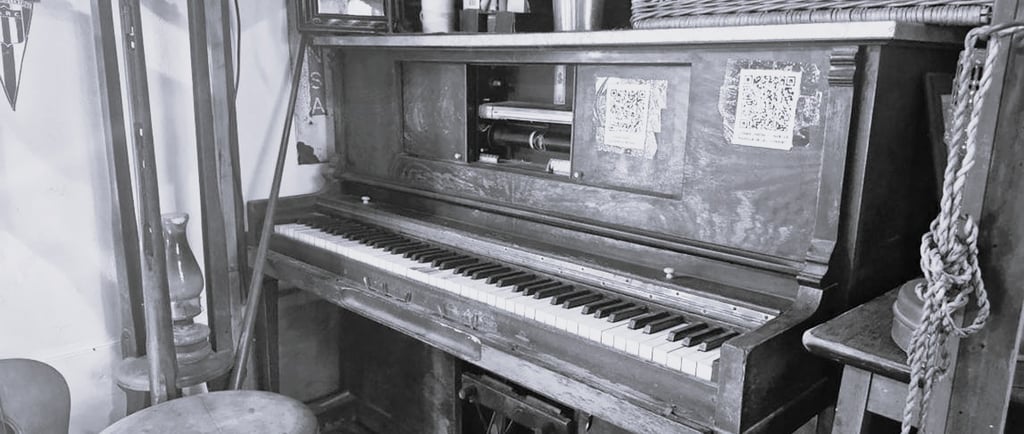
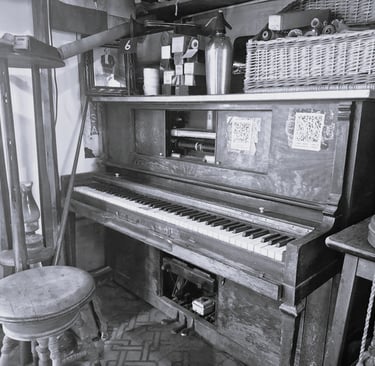
Little Irving Feldman was supposed to grow up to be a concert pianist and build ornate sonic cathedrals out of Bach’s Goldberg Variations. What would his mother say, he sometimes wondered, if she knew he ended up playing ragtime in a Mexican whorehouse?
To be fair, Ramon’s wasn’t exactly a whorehouse. It was a waterfront cantina, favored by the better class of sailors and the lower class of import-export men. If it was a popular spot to meet sporting women, those women weren’t directly employed by Ramon. And if those meetings led to private encounters in rented rooms, those rooms weren’t on Ramon’s premises.
Grown-up Irv (Fingers) Feldman insisted to himself during late-night audits of his soul that his mother need not bemoan her years of scrimping to pay for a piano and lessons. The ragtime he played allowed for considerable improvisation, so it wasn’t uncommon for Irv to incorporate a few lines of Bach into an extended bit of noodling. Irv never made it to Carnegie Hall, but maybe Miriam Feldman would take comfort in knowing that he brought the greatest works of the Baroque age to an audience that would not otherwise enjoy such cultural enrichment.
It was the goddam piano that got Irv into this jackpot.
He’d just finished the Mexican crowd-pleaser Cielito Lindo – joining the crowd in singing the “Aye Aye Aye Aye” refrain – and when it was finished he vamped through eight bars each of Bach and Stephen Foster and paused for a leak and a cerveza.
Before he could get away, a little round-faced fellow in a garish four-button sack coat and shiny brilliantined hair stuffed a wad of pesos in the tip jar and asked, in a German accent, “What is a virtuoso such as yourself doing in Veracruz, my friend?”
“That’s a long story,” Irv said, eyeing the bills. “You got a request to go with that dinero, amigo?”
“Do you know ragtime?” The little German asked, leaning over Irv’s piano to gush, “Le tout Hamburg sont fou pour le ragtime.”
Wondering what it was about queers that made them break into French at the drop of a beret, Irv launched into The Maple Leaf Rag, and his new admirer glowed with delight, pudgy fingers miming a parade up and down a keyboard in the air.
Thus began a business relationship with ship’s purser Pieter Schmidt.
Over the course of the evening, after topping up Irv’s tip jar again and waving the waiter over for rounds of mezcal, Schmidt asked if Irv knew where a man could acquire a little extra energy to enjoy his limited free time on shore. Would the good monsieur be able to assist in acquiring un soupcon of cocaine?
Irv’s tastes in medication ran more toward a relaxing bowl of opium – which had led to debts that he couldn’t repay in San Francisco and New Orleans and to his current sojourn in Veracruz. But keeping the music flowing during a long night at Ramon’s did sometimes require a little pick-me-up around one or two in the morning. He knew where to go shopping.
Irv asked how much Schmidt required and named a price – which included a commission for arranging the transaction. During a break in the music, he ventured across the street and whispered in the ear of a shoeshine boy, who disappeared around the corner. Minutes later, an old Indian woman arrived with tamales in a paper wrapper. He paid the woman for the tamales, unwrapping one to reveal a salt shaker filled with white powder.
After exchanging the salt shaker with Schmidt, Irv returned to the piano before the patrons at Ramon’s could become too restless. From behind the bar Ramon gave Irv an admonishing look. Sometimes music was the only thing that kept knives from being unsheathed. Sometimes it was the only thing muffling the sound of a knife fight.
The last time Irv saw Pieter Schmidt that night, the purser was leading a young sailor with the face of a Caravaggio saint out the door. So that was what the extra energy was for, Irv thought.
Schmidt was back the next night requesting more ragtime and more of Irv’s time.
“La musica regresa en quince minutos,” Irv announced after a series of especially energetic numbers that gave his fingers a workout. Wrapping them around a cold bottle of beer, he joined Schmidt in a quiet corner of the room.
“I trust you had an enjoyable evening, Herr Schmidt?”
“The young Adonis and his friends certainly did,” Schmidt replied. “I do not indulge, myself, in such substances.”
Schmidt revealed that his job gave him access to any number of hiding places on his ship, SS Ypiranga, an 8,000-ton freighter running the Hamburg-Mexico route. Now that Schmidt knew Irv’s supplier provided cocaine of reasonable purity, he would be interested in acquiring a larger quantity to take home to friends in Germany. “It is absolument de rigeur among les jeunes a la mode in Hamburg.”
“Why me?” Irv asked. “Couldn’t you deal directly with a supplier and save yourself my cut?”
“I find it worth ten per cent to work with an entrepreneur who knows Veracruz and is tres sympathique. And un artiste!”
“Twenty.”
“I like a man who knows his worth.”
Three times Pieter Schmidt had returned to Veracruz, and each time Irv had brokered the sale of cocaine, the amount of product increasing steadily, but still, Irv hoped, small enough not to attract a dangerous level of scrutiny.
Irv’s proceeds allowed him to move farther from the squalor of the waterfront. He took a room in a grand house owned by the young widow of an army major who’d been killed in Mexico’s continuing revolution. By renting out three rooms on one floor, Maria Espinoza made enough of an income to feed herself, two servants and the baby she’d been left with as a reminder of her bereavement.
It was the baby that brought Irv and Maria together. The baby and Johann Sebastian Bach. Little Antonio was colicky and when he awoke in the middle of the night his crying was often enough to disturb everybody’s sleep. Irv remembered his mother telling him that when he’d been a crying baby, she’d sung to him, mostly old Yiddish songs. Irv didn’t think his own singing voice would soothe a troubled soul, but one night when he returned from Ramon’s and Antonio was keeping all the residents of the house awake, Irv had sat down at the piano in the parlor and played Bach.
Maybe it was the intricacy of the music that drew the child’s attention away from whatever pains, physical or psychic, had gripped him. Irv played and through the door to Maria’s rooms he heard Antonio babble happily, then go quiet.
In the afternoons when Irv woke from his slumbers, he’d often hear Antonio resisting Maria’s efforts to take a nap. And so he began visiting the parlor in the daytime, adding Beethoven’s Moonlight Sonata and a bit of Mozart – well, Twinkle Twinkle Little Star anyway – to the child’s musical education. Maria would bring Antonio out to watch and Maria and Irv would hold long wordless conversations while his fingers told his story and the cleaning lady or the cook bustled about acting as self-appointed chaperones.
Their time together in the parlor provided a calm, safe haven in a storm.
Mexico was wracked by war, but that was nothing new. First, Francisco Madero, with support from the northern bandit Pancho Villa, ousted the old dictator, Porfirio Diaz. Then one of Diaz’s generals, Victoriano Huerta, launched a coup and took control of the nation, resulting in a war against the constitutionalist politician Venustiano Carranza, Villa and an Indian peasant leader named Emiliano Zapata. The latest war had not yet touched Veracruz, but it was only a matter of time.
For now, Veracruz was a place to make a quick profit from Mexico’s principal Gulf port and every military and police official in the city had his hand out for bribes from the harbor’s smugglers. Fingers Feldman was no fool. And he knew something about what Pieter Schmidt would call le demi-monde criminel, having grown up with a father who worked in gambling operations along the waterfronts of San Francisco and Los Angeles. He knew that small-time operators were always at risk of elimination, that the harbor master – a Huerta crony – might learn of Schmidt’s shipments and demand the business for himself, that the temptation for one more big payday was often deadly.
Irv and Maria did not dwell on the dangers around them. Weeks became months. The baby became a toddler. Music became a shared pleasure, rather than a sleeping spell. Maria would find excuses to send the servants on errands or wait until they were away at mass and then she would join Irv at the bench for a piano lesson. It was all very proper and innocent, but sometimes their hands would become entwined on the keyboard.
Eventually, they threw aside propriety and spent time together outside of the house. They rode along the Malecon in Maria’s carriage, the clip clop of the horses lulling Antonio to sleep. They took off their shoes and waded in the water at Playa Norte, delighting as the little boy splashed in the ripples along the shore. Irv feared that Maria’s flaunting of social norms could call down punishment on them both, but she was so happy to break out of the role of grieving widow and he could not resist seeing her smile.
As he learned more about her story, the family pressure to marry the powerful widower who came courting in his officer’s uniform, her isolated life at the major’s country house, now destroyed in the war, the fortune she lost with her husband’s death, he came to realize what a change it was for her to smile.
If not for Maria, Irv wouldn’t have agreed to purchase ten kilograms of cocaine for one last exchange. He took all he had made in the first deals and borrowed a wad of hard currency – his dealer had lost whatever faith he’d had in the soundness of peso – from a shylock who owned a piece of Ramon’s and half of the brothels, clip joints and gambling parlors in Veracruz. The vig would eat into Irv’s profits, but still leave him with enough to offer Maria an escape from Veracruz.
The white powder arrived on a banana boat from Guatemala. Irv made the purchase and waited for Pieter Schmidt to arrive on the Ypiranga and hand him the keys to a better future.
And then the U.S. Navy showed up. The fleet arrived in the night and news traveled from the harbor to Ramon’s as Irv played. He ran home to tell Maria.
“The yanquis are here, Maria. There’s going to be a battle. You should go someplace safe.”
Maria didn’t look frightened. If anything, she looked proud.
“There is no safe place in Mexico,” she said. “Not while Huerta rules.”
“Didn’t your husband serve with Huerta?”
“To his shame. I know of Huerta’s crimes. And I know about the shipment of arms coming to the port.”
“What shipment?”
“On a ship from Germany. American weapons sent to Europe to bypass the arms embargo. I have heard of all this from my husband’s family. They think I will be pleased that Huerta will have the weapons to fight against those who demand justice and freedom.” The look of defiance on Maria’s face gave her a terribly beauty. “How shocked they would be if they knew I informed the Americans about the shipment.”
“You did?”
“The yanquis have not always been friends of the Mexican people. But we thank President Wilson for cutting off Huerta’s weapons.”
A round of thunder from the direction of the harbor rattled the windows as Woodrow Wilson’s guns announced the beginning of the American invasion.
Maria was elated. She embraced Irv and Irv returned the embrace. The guns woke Antonio and Irv played the piano to calm the boy. Maria joined him on the piano bench and requested, in honor of what she called the liberators of Veracruz, The Star Spangled Banner. Irv turned to her and kissed her, quickly, before the servants could show up and get in the way. She kissed him back.
In the morning, U.S. Marines poured off the American fleet and seized the harbor. A few Mexican cadets tried to hold out in a short battle, but soon the city was locked down tight. Ramon’s was closed by order of the occupying authorities.
A telegram brought Irv the news that the Ypiranga had been diverted to Puerto Mexico, 150 kilometres south and still controlled by Huerta. Schmidt would await the cocaine there. All Irv had to do was board a train while carrying a bag of cocaine and run a gauntlet of soldiers, revolutionaries, bandits and, quite likely, double-crossing criminal associates in the midst of civil war. Then run the same gauntlet in reverse with a bag of cash.
He journeyed through eerily quiet streets to the waterfront and explained his dilemma to the shylock, asking if the man would accept the cocaine in lieu of cash.
“No Senor Feldman, I want money. It would be very bad for you if I do not get it. And very bad for the beautiful young widow.”
More ominous news came to him at Maria’s.
“They know it was me,” Maria said. “My husband’s uncle doubted my loyalty. He had me watched. His men saw me go to the American consulate. A spy in the consulate has confirmed that I informed the Americans about the weapons.”
If Huerta regained control when the American occupation ended, Maria’s life would be forfeit. And whatever happened in the civil war, if Irv failed to make good on his debt to the moneylender, Maria would pay.
Irv told Maria everything.
“You have to leave,” he said. “Huerta’s men will be watching the train to Mexico City. Take Antonio and ride west. Wear old clothes, cover your hair, leave the carriage at home. Take the backroads.”
They arranged to meet in a village two days journey west of Veracruz, at the rectory of a priest Maria knew to be sympathetic to the constitutionalists. Irv would meet her there in a few days with money from his deal with Pieter Schmidt. Together, they would continue through the mountains to Cuernavaca, stronghold of Zapata, where Maria would be a hero for preventing the arming of the dictator’s forces.
Irv set off immediately, carrying the cocaine in a carpetbag, hoping it looked like something a travelling drygoods salesman might use to carry samples. He sat in the second-class compartment with the bag pressing down on his lap, feeling the seconds tick past as the train to Puerto Mexico jostled and swayed and sweat formed on his neck and slipped down his back. With each movement, as he shifted the weight from one thigh to another, the barrel of the .32 Browning, a gift that had been presented to Maria’s husband, dug into the skin along his spine. The ball of his right ankle was raw from rubbing against the little Colt vest pistol he’d hidden in his boot. Irv hoped he would not need the weapons. He hoped as well that he would know how to use them if he had to.
It was night when the train arrived in Puerto Mexico. The town was bustling with traffic that had been diverted by the attack on Veracruz. Soldiers safeguarded the weapons that had been delivered on the Ypiranga, patrolled the streets, and packed the cantinas. Somehow, nobody asked him for documents or inspected his carpetbag. Irv found Schmidt’s hotel without incident and allowed himself to hope his mission would soon end in success.
“Please may I inspect the medication?” Pieter Schmidt asked, after the preliminaries were out of the way.
“Please do,” Irv said, removing four flour sacks and opening one.
Schmidt tested the contents of the first bag, then opened each of the others and tested them, dissolving small amounts of the drug in vials of bleach, holding them up to the light to look for residue. When the powder passed that test, he taste-tested it. Finally, he dipped a tiny spoon into the powder and offered Irv a sniff, then took one himself.
The instant elation and jolt of energy dispelled any lingering doubt.
“My friends will be delighted with this,” Schmidt said. “From the North Sea to the Alps, 1914 will be a year of dancing and laughter throughout Germany.”
“Well, don’t ask me for more in 1915. I’m retiring from the business.”
“It has been a pleasure doing business with mon ami Americain,” Schmidt said, clicking his heels like a Prussian officer, then grasping Irv’s shoulders and kissing his cheeks like Frenchman saluting a hero of the Third Republic.
Schmidt handed over a pouch and gestured for Irv to count the bills. It was the agreed-upon sum – enough to pay off the shylock in full and take Maria west, where they could wait for peace to return to Mexico.
“You take the morning train back to Veracruz?”
“Should be there by noon if nothing breaks down.”
Schmidt’s countenance grew serious. He gestured for Irv to sit.
“Have you considered leaving Mexico now while you can? With this money, you could buy a cabin in my ship for the return voyage. Certainly, you would be a sensation playing ragtime in the bierstubes along the Reeperbahn, but I am sure you have the talent to aim higher. I would love to hear you at the Konzerthaus in Berlin.”
Irv smiled at the thought. His mother would certainly be proud.
“Maybe next year,” he said. “I’ll do a concert tour from Paris to Berlin.”
They shook hands and Irv took to his own room, where he placed a chair behind the door, tied the money pouch around his waist, and lay with the Browning near his hand. Sleep didn’t come easily, if at all, and heightened nerves kept him wide awake as he took his seat on the train and waited for movement. Hours later, the rhythm of the wheels allowed his fatigue to catch up with him and he found himself on a piano bench in formal attire in a grand concert hall, then back on worn leather upholstery in a cramped railcar smelling of sweat, tobacco and beans.
The train lurched and Irv looked out the window and saw only the lush forests of the Gulf Coast. Yet the train squealed to a stop. The other passengers appeared equally startled. This was not scheduled. Irv stood, feeling under his jacket for the money pouch, and looked out the windows to right and left. Men approached beside the tracks on each side.
Voices from the car immediately ahead of his grew louder. He hurried to the far end of his own car and drew the Browning and the Colt and waited.
He heard the screams of the other passengers and he heard the percussion of gunshots and echoes. He smelled gunpowder. He felt a sudden burning pain and as it was replaced with a growing cold, the chaos of the train car faded away. Now he heard someone call Maria’s name, telling her to go on to Cuernavaca without him. And he heard the goddam piano that started all this: the piano that brought Maria to him, the piano that drove away night terrors, the piano that silenced all weeping.
BIO: Bob Armstrong lives in Winnipeg, Canada, where he writes novels, short fiction, Substack essays and every genre but poetry and ransom notes. His short story Thank You For Being a Mark was published in January 2026 by Literary Garage. His western novel, Prodigies, was published in 2025 by Mad Cat/Roan & Weatherford, and a sequel is scheduled for fall 2026.
Follow on Social
Literary Garage: Storytelling with grit, heart, and no off-ramp.
© 2025. All rights reserved.
Connect


editor@literarygarage.com
Follow us on Substack for updates and news
Clicking thE SUBSTACK link will direct you to an external website for our Substack feed. The content and privacy practices of Substack are not controlled, and no responsibility is taken for any issues that may arise on the platform.
Editor-In-Chief: Kevin Christopher Michaels
Special Features Editor and Warrior God: Michael Downing