
The Drowned Wife
SHORT FICTION
By M.D. Smith IV
2/12/2026
I got the call just after noon—the hour when the sun hangs high and merciless, when lies begin to sweat through their shirts.
“Body in the water,” the dispatcher said. “Male caller. Jason Pierce. Says it’s his wife.”
The drive out took me past the city’s last gasps of civilization—the final strip mall with its flickering neon, the last cell tower standing like a lonely sentinel—until the road thinned into a cracked ribbon swallowed by pines. The trees leaned inward as if eavesdropping, their branches knitting together like fingers hiding a secret.
The lake waited at the end of the road, a flat gray coin tossed onto the earth by a careless god. The sky above it was battleship gray, the kind of sky that makes you feel it has secrets.
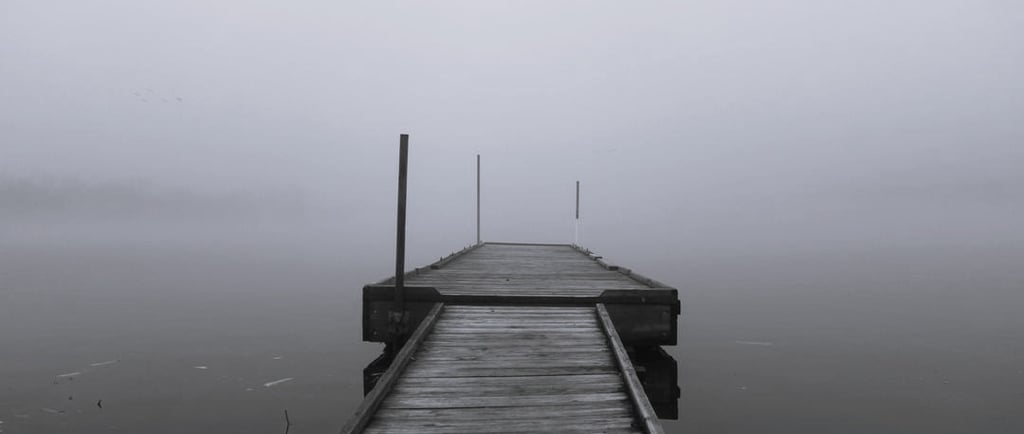
A modest house crouched near the shoreline, paint peeling, shutters sagging, the kind of place people buy when they want quiet so badly they’re willing to risk being alone with themselves. And they don’t want to spend time repairing anything. A narrow dock jutted out like a pointing finger, accusing the water.
Uniforms and EMTs milled around, their navy jackets and reflective stripes catching the dull light. The air smelled of wet wood and something older—something that had been waiting.
The husband sat on the dock steps, shoulders slumped inward, hands knotted so tightly his knuckles looked skeleton white. He wore a checked flannel shirt two sizes too big, the sleeves rolled sloppily, jeans soaked at the cuffs. His fishing boat bumped the pilings in a slow, rhythmic thud, like a heartbeat trying to remember its purpose.
He looked up at me with eyes that had aged a decade in an hour.
“I just came back,” he said, voice hollow as an empty well. “She always liked that dress. The blue one… with the little white flowers.” He swallowed hard. “I made her a sandwich last night. She forgot it on the counter. I took it with me when I left at daylight, and ate it for brunch.”
He said it like it mattered. Like sandwiches could save the dead.
We found her where Pierce said he’d dragged her to shore—a pale shape against the reeds, hair fanned out like dark kelp. No wounds. No splintered boards. No signs of struggle. Just a woman who had stepped into the lake and never stepped back out. Someone could have held her under and left by car or boat. Or maybe Pierce lever left the dock and she walked down to her fate later that morning.
His story was weaker than iced tea left too long in the sun.
Her name was Laura Pierce. Thirty-four. Married six years.
By sundown, her husband sat in an interview room, a paper cup of water untouched in front of him. The fluorescent lights buzzed overhead, casting sickly halos on the walls. I sat across from him, the one-way mirror behind me reflecting only ghosts.
“You were alone all morning? Fishing.”
“Yes.”
“No witnesses.”
“No.”
“You argued recently.”
“Yes.”
He didn’t dodge. Didn’t flinch. Didn’t try to paint himself cleaner. That bothered the others more than any lie would have.
Later, I stood behind the glass with two detectives, watching them lean on him—too hard, like men trying to force truth out of stone. Voices rose. Photos slapped the table. The dress. The dock. The faint waterline on her throat.
Then they brought out the diary.
A leather-bound thing, edges worn soft, found in her nightstand like a secret she’d meant to hide better. A week-old entry, written in tight, slanted script:
I’m afraid he’ll kill me someday. I feel trapped. I don’t see a way out.
Silence fell like dust.
He stared at the page as if it were written in a language only the dead could read. His face shifted—confusion, grief, disbelief—before he finally whispered, “She never told me that. She never told me she was scared.”
They booked him that night.
For days, the case sat on everyone’s desk like a gift-wrapped conviction. No alibi. Marital strain. A drowned wife. A story juries swallow whole.
But easy cases rot fast if you don’t keep them cold.
The preliminary autopsy came back: water in the lungs. Drowning. But no defensive wounds. No bruises. No signs of being held under. It looked open and shut—but Pierce didn’t fit the mold of a man who kills his wife. He wore guilt like a coat he didn’t remember putting on.
Then toxicology arrived.
Antidepressants. Opioids. Benzodiazepines.
Enough to turn the world into a soft-edged dream. Enough to make the floor tilt. Enough to make a person forget which way was up.
I dug deeper.
Laura had quit her job six months earlier. Bad hip. Chronic pain. Weekly psychiatrist visits. Prescriptions refilled faster than rain fills a gutter.
When I counted her pills, the numbers whispered wrong. One bottle should’ve held fifty-five. It held nine.
I called her sister in Ohio. At first, silence. Then the kind of crying that sounds like something breaking loose inside a person.
“She hated him at the end,” the sister said. “Or maybe she hated herself. She said he wanted more—a bigger house, kids—and she felt… broken.”
“Did she talk about hurting herself?”
A long pause. A breath. A confession.
“She said once…if she disappeared, at least he’d finally be free. And maybe he’d pay for wanting more than she could give.”
That’s when the diary entry twisted into its true shape.
Not fear. Projection.
We rebuilt the timeline. Laura alone that morning. Pills swallowed mid-morning. She walked onto the dock dizzy, numb, anger blooming like a bruise. She knew the pills would kill her.
She knew he’d find her. She knew what it would look like.
She drowned, yes.
But not because anyone pushed her.
She wanted to take him with her—if not in body, then in blame.
The charges were dropped quietly. Departments don’t like admitting mistakes, especially the kind that echo.
Pierce walked out of jail thinner, eyes dimmed, wearing the weight of a woman who had turned her pain into a weapon.
I watched him leave.
He didn’t look free. Just emptied.
Back at my desk, I wrote the final line:
Cause of death: drowning due to intoxication. Manner of death: suicide.
Outside, the lake lay still, its surface smooth as a sealed envelope.
It keeps its secrets. It always does.
Some people drown in water. Others drown in blame. And sometimes, they try to pull someone else under with them.
Bio: M.D. Smith of Huntsville, Alabama, writer of over 350 flash stories, has published digitally in Frontier Times, Flash Fiction Magazine, Bewilderingstories.com, and many more. Retired from running a television station, he lives with his wife of 64 years and three cats. https://mdsmithiv.com/
Follow on Social
Literary Garage: Storytelling with grit, heart, and no off-ramp.
© 2025. All rights reserved.
Connect


editor@literarygarage.com
Follow us on Substack for updates and news
Clicking thE SUBSTACK link will direct you to an external website for our Substack feed. The content and privacy practices of Substack are not controlled, and no responsibility is taken for any issues that may arise on the platform.
Editor-In-Chief: Kevin Christopher Michaels
Special Features Editor and Warrior God: Michael Downing