
The Business Trip
A story about the weight of expectations
STORIES
By H. M. Wilson
7/17/2026
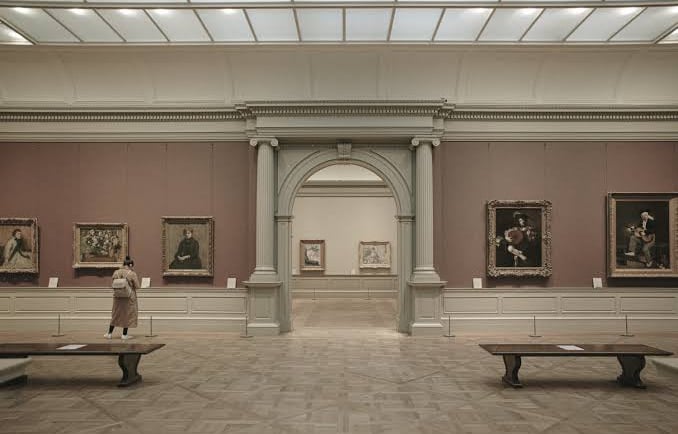
I was explaining the exhibit as I walked in the door.
“You had time to go to a museum? I thought it was wall to wall meetings,” she interrupts.
“I went yesterday. Before the flight to Madrid.”
“Time for a museum, but you didn’t call me much,” she says. All this already and I’m still just in the foyer.
“I called three times,” I say.
She looks at me, eyebrows raised. Maybe she’s kidding. I test the theory and give her a kiss. She smiles, dusting the imaginary lint off my sleeves.
“And I knew you’d be busy anyway,” I say. An unnecessary risk to the peace. I wanted to know if she’d come out and say it. Say that she’d been busy. Or if we really were just past the point of communicating about it, her second life.
“Not really,” she says on her way back to the couch. I leave my suitcase there beside her and get some water from the kitchen.
“Did you go alone? To the museum?” She asks. I can see from where I stand, glass in hand, that she’s looking at her phone already. Even from the kitchen I can see it. Her reflection in the window of the living room transposed over our front lawn. Her body looks tiny in the pane, in comparison to the couch. The whole space looks bigger after a week in a hotel room. And us, so much smaller than all of it. And I can’t help but see only brands. I live in an altar to West Elm and Sony.
“Alec?”
“Sorry, yeah, of course I did. They all slept in.”
“They don’t like art?”
“They buy art at auctions to show off their money.”
“Just like dad.”
“In his spitting image.”
“Jesus,” she says, as I sit down beside her, “Well, tell me about it then. Sounds like it really struck a chord if you’re still thinking about it.”
“Yeah, I can’t get it out of my head. Like, what it means. It was an American artist. Can’t remember her name. The first piece sucked, I almost left. It was just like vaguely provocative words all over the walls. That was all. But upstairs—”
“It was two floors?”
“The whole museum is four, I think. This one was on two. And upstairs, it started with these posters. All the images were familiar. Like, memes and viral stuff. Brands. Grumpy cat and burning ATMs. And then slogans on top of them. Random ones. Like, ‘my body my choice,’ or ‘we accept the love we think we deserve.’ Even ‘click it or tick it,’ was on one. It was crazy.”
“That was it?”
“Well, there was also a video component. One part was a scrolling screen, with an interview question, ‘What does the art mean?’ And then the rest was just possible answers. And they all sounded like when someone would raise their hand in class and try hard to say what the teacher wanted them to say. It was funny. But the biggest part was a video. It was like the posters but in video form. Oh, and throughout all of it, in the background, there was a voice just playing over and over again, ‘Hello?’ and ‘I love you.’ As people were looking at the art, and each time the voice would play, they’d all be looking around, I’d be looking around, like who said that?”
“Contemporary art is weird. I’m surprised you like that. I thought you hated stuff like that,” she says, studying me.
“Really?”
“Remember when we could have gone to the MOMA, like two years ago?”
“Well, the choice was museum with your parents or bar with our friends if I remember correctly.”
“I guess,” she crosses her legs and faces me, pushing her long blond hair behind her ears, “I just didn’t realize this was an interest of yours.”
“I didn’t either. I mean, it felt like a voice in the night, the ‘Hello?’ and ‘I love you’ thing. Through all the images. The slogans. The violence. It was inundating. It felt like an exaggerated experience of being on my phone. Do you ever feel that way?”
“I don’t know. I’m not on my phone as much as you.”
“Says the woman looking at her phone now. And also, weren’t you just telling me I should have been calling you more?”
“Well, sorry,” she said, “I missed you. And I was just checking the time. We have an hour to get there. Traffic looked a little crazy.”
“I’ll go get ready.”
“Oh, what about the account? I ask how you are and all you tell me about is this weird art exhibit.”
“Your dad didn’t tell you?”
“Alec—” she says, but I’m already halfway up the stairs. I pass pictures of us looking at me from the wall by the staircase. And the passing of time feels acute.
I splash cold water on my face. Through the sting in my eyes, I see two towels hanging on the door. I go to dry off, but they’re both damp. She couldn’t have even tried to hide it.
“Alec!” She yells.
“I just need a minute!” I yell back, eyes closed and digging in the closet for something dry. I let my suit pants and button-up fall in a lump and grab jeans and a polo from my drawer. When I’m fixing my hair, I notice his cologne on the sink. Can only be his because I don’t have any. Smells like middle school locker room. I almost put it in the trash but then I think better of it and spray myself liberally.
“Are you kidding?” she asks in the car, coughing, “Are you trying to gas me out? Or is this your way of making me feel guilty?”
“Are you guilty?”
She opens the window and says, “No, I’m not. I thought we were all good Alec, I mean, you knew about this. We’ve had the conversation.”
“Months ago. Agree once and set for life, is that it?” I ask, adjusting the mirrors as we wait at a light.
“Alec, can’t we just be okay? I missed you. And you know that it would be your responsibility to tell me directly if you have an issue. Not be passive aggressive like this. We’re adults. We’re not responsible for each other’s feelings.”
“Fine, I just—”
“And honestly, if you want to go there, if you would just deal with your issue we wouldn’t be in this position.”
“My issue?”
“Yes,” she says, staring right at my cheek.
We come to a stop and I stare back.
“You mean my medication,” I say.
“Have you even talked to your doctor about alternatives?”
“It is helping me.”
“Hurting us.”
“That’s not fair,” I say. We start to crawl along the highway.
“Maybe your issue isn’t your issue.”
“Then what is? If you know everything?”
“I don’t know everything, Alec. And you are escalating. I’m not going to engage when you are escalating. You are not yourself when you do that.”
Taking the exit, we pass the strip malls that mark the border between the have-somes and the have-everythings. I try to imagine what she’s seeing now, staring down at her phone. Probably a friend’s story. Or my story. She’s always on stories. More likely, his story. Probably a shirtless picture at the gym. Not that I know what he looks like. Successfully avoided that. Though I know what he smells like now.
The radio plays ads for a local car dealership. A trade-in deal with a lifetime warranty. A raffle for Justin Timberlake tickets, “It’s a revival,” the host says. I turn it down.
“Look, I’m sorry,” I say, “It’s the jet lag. And honestly, I just feel weird. I can’t stop thinking about that exhibit. Like it just captured the noise that is everywhere. And like, the feeling of screaming over everything. Except no one is hearing. They’re screaming too. And like, what’s the point?”
“Oh sorry, did you say something?”
“Nice one.”
“I’m just teasing. It’s okay. I understand. I mean, it seems like it really moved you. It’s good to be moved and appreciate art. I was just surprised you took an interest. Never known you to have interests like that. But I think it’s great.”
“I’m not a work robot.”
“Well, you have been kind of, not that I think it’s a bad thing. I know it’s what dad wants,” she says, “By the way. I want to know what I’m walking into. How did it go?”
“I got it.”
“I knew you could do it,” she squeezes my leg, “Dad’s probably psyched for you.”
I smile, but it doesn’t feel like I thought it would, like a win. We had money before, and now we’ll have more. What’s there to feel? The only thing I feel is the desire to crash the car into the big oak tree before her parents’ gate. But instead, I just pull up to the buzzer.
“Mommy!” she says, getting out and running across the driveway. Her mother, with her highly customized frozen face, looks forty. I smile at her through the afternoon sun. Her face moves in what might have at some point been a smile.
“There he is,” her dad says, emerging from the door, bigger than all of them. He looks like a senior citizen next to his wife with his untreated wrinkles and soft body.
“You finally did it!” He claps me on the back. Bit of edge on that finally. Throws me off balance.
“It is done,” I say.
“God, don’t you ever loosen up. You can relax. You did it. Your shoulders are to your ears. Let’s get you a drink.”
“You know Alec doesn’t drink, Daddy,” My wife says, after he’s gestured us all inside.
“Well, it’s not like he’s an alcoholic, is he?”
“No,” I answer for myself, despite my wife’s glare, “Just hate being hungover.”
“Well, to celebrate you should have a drink. You can take tomorrow off. I’ll tell them. It’s your first account. Even if it is a little Spanish one.”
“Basque,” I say, following him down the hallway. My wife and her mom head to the kitchen, their voices fading, having a different conversation.
“Basque, Spanish. Same thing,” he says, handing me a tumbler with whiskey. We’re in his study. Books line the walls and look as they always do, untouched. There’s art that costs more than the downpayment on my condo looking down at me.
“Anyway, did you enjoy the trip? Bilbao?” he asks, letting himself down in the big leather chair behind his desk. I sit across from him.
“Sure, yeah. It’s a cool city.”
“I heard you were MIA yesterday,” he says, arms crossed.
“I went to the Guggenheim.”
“The museum? Huh. I never pegged you for that kind of guy. Don’t get me wrong, I love art.” He gestures around the room.
“Well, no. Not usually. But I didn’t feel like another bar crawl.”
“How was it then?”
“Good,” I say, wondering what he’d think about the exhibit and what it means. That’s how much it’s gripping me. But something’s changed between us; the feeling of being in the room with him is different.
“You okay, space cadet?”
“Sorry, yeah. You know, there was one exhibit that’s really fucking with me.” There’s no harm, I figure.
“Oh yeah?”
“Yeah, it was huge. The main part was like a video with a bunch of flashing slogans and viral images. Just to show how much is shoved in our faces all the time. And yeah, I keep thinking about it. Like now, everything in front of me feels like a big ad. And like, what’s the point?”
“Woah, there. Getting deep on me,” he laughs and turns around, messing with one of his drawers.
“Yeah, I don’t know. Really made me think I guess.”
He turns around, but only halfway, “I get it. With these phones and all. Though there’s nothing bad with seeing ads everywhere. Consumers can make the best choice out of many.”
“But like, at what cost I guess?”
“What, did you come back a socialist? I hope not,” he laughs, facing away again, “It’s good to think though. Makes you more agile on your feet.”
He wheels back around in his chair, holding a shiny Rolex.
“Look, Alec, not to change the subject, and as much as I’d love to hear your art criticism. I’ve been saving this for this moment. Your first account. That’s all yours.”
“I don’t know what to say.” He hands me the shiny, silent watch. I look at it, and the one on my wrist with its faux-leather strap.
“You’re a man now. Your decisions will make your career. Make your life. That’s what it symbolizes. I can’t guide you any longer. Generally speaking. Of course I’ll always be here.”
“Where were you guiding me?” I ask, looking up at him.
“You’re philosophical today,” he says as he pulls two cigars out from a wooden box, decorated with a relief of Havana.
“I mean, thank you.”
“Of course, son. When I got my first account, my dad gave me that. You’ll have men under you one day. You’ll be able to afford a better one. And you’ll pass it along to your best. A kind of tradition. Maybe your son.”
He lights his cigar, his yellowing teeth just visible. Then he lights mine. I mask a grimace. Never liked the taste. Like smokey piss.
“It means a lot,” I say, though I’m not sure it means anything. He raises his glass and I follow suit.
“Anyway, speaking of kids, I hope the stability helps your issue,” he says, kicking his feet up on the desk.
“My issue?”
“She told us,” he says, “It’s a family matter, after all.”
“Well, I—”
“Look, I only bring it up because I actually know a guy, a doctor,” he passes me a business card with shiny raised letters.
“A doctor of what?” I ask, looking down at the card then back at my father in-law, who is now standing, looking out the window. I want him to just say it.
“You can call him on the number there and see for yourself, though I’m sure you get my gist.”
“Right,” I say. He won’t just say it. Of course I get the gist. I’ve traveled with him before; I know the company he keeps.
“And look, sure, I don’t always use it for noble purposes, sue me,” he comes back to the desk, sitting on the edge now. I wonder if it will hold him. I imagine it falling and him falling, embarrassed and in a heap. But he wouldn’t be embarrassed. He’s never been embarrassed.
“But you,” he continues, “this would be a noble purpose. You know how much she loves you. And how much she wants a family.”
“I actually—”
“Just think about it. I have to piss,” he gets up and squeezes my shoulder before heading down the hall. Alone in the room, I lean back in my chair, my head up at the ceiling. I don’t want kids, though, I say in whisper. I close my eyes until they hurt and then open them to the fuzzy study. I take a deep breath and put the watch on.
The bathroom door creaks and he comes back into the room and picks up his cigar. It’s hanging off the corner of his mouth, drooping.
“Anyway, where were we? You smell great, by the way.”
“We’ve covered a lot,” I say. Remember who you’re with. Don’t react.
“Oh, there was more I wanted to say on the doctor thing. I think this is all part of it. You know, the fact of you being raised by single mother. You didn’t have anyone to talk straight to you about these things.”
“Right,” I say, drinking the last of my whiskey fighting the urge to throw the glass in his face. How dare he, I think and clench my jaw.
“So, you’re lucky to have me,” he says and I keep it together.
I even give a smile and nod before I hear myself say, “I know. Thank you for everything, sir.”
“When are you going to stop calling me that?”
“Comes naturally,” I say, lying.
“Well, you don’t have to, and anyway, I’m just happy to help.” He hikes up his jeans, his belly moving with the waist.
“I think they expect me to grill,” he says, “Want to join?”
“I’ll meet you out there,” I say, looking around at the shelves, trying to come up with a reason to delay. A second alone.
“What, first a museum, and now books?” He runs a hand through his hair, thick from the transplant. It stays in place.
“Yeah, sure,” I say, standing up.
“Well, grab what you want, and anyway I’m on to you,” he says, holding onto the door frame, “I know you want to look at the guns.”
“You know me,” I say, smiling.
“Just be careful,” he says, “Remember what I showed you at the range.”
“Hey now,” I say, “You know I’m a natural.”
“That was beginner’s luck. I just don’t want you shooting yourself.”
“That’s just what I plan to do,” I say, walking over to the shelf.
“And see, now you’re joking. Whiskey helps. But I see what this is. And take your time. I’d stay in here if I could, but you know the girls would come looking. It’s like another gift from me. And by the way, take the junky one off now. You can’t wear both.”
“They show two different times,” I say. But he’s already gone. I pour more whiskey into my glass and drink it in a fell swoop.
The thing about his library is that it’s just Encyclopedia Britannica and biographies. And it’s all just background for the guns, laying on their stands over the purple velvet. I lift the glass case and pick up a pistol, the 1911, and turn it over in my hands. I know after going to the range that he keeps the magazine in the drawer just under the display. Certainly a safety issue. But nonetheless. I spin the top bullet with my thumb.
I walk toward the end table by his desk, where the whiskey decanter sits, still open. I pour myself more. There’s a mirror on the wall just above it. I watch the glass go clear and set it down. I see myself. I aim.
“What are you doing? You shouldn’t mess around with that.” My wife says, leaning against the door frame.
“Just looking,” I say, lowering the gun and turning toward her.
“Dad said you’re funny today,” she says, “I told him he shouldn’t have given you whiskey. Are you okay?”
“Fine,” I say from the bookshelves, where I’ve put the gun back down. I walk over to the door and she kisses me. Then, she takes off my watch and tucks it in my pocket.
“It’s really nice,” she says, looking at the Rolex, now alone on my wrist.
“Did you know?”
“I knew it was his plan for your first big win,” she says, “He couldn’t wait. Are you coming?”
“I have to go to the bathroom, I’ll see you out there,” I say.
“You are being weird,” she says, eyebrows turned in, “And I can smell the whiskey. Are you sure it’s okay for you to drink? It’s been years.”
“It’s fine,” I say.
She kisses me on the cheek and leaves. I kick the door closed. I lean over the sink and look into the mirror. Behind me there’s a jungle theme, tropical birds and monkeys, ecologically inaccurate as it is, elephants and crocodiles. And of course, the explorers, with their khakis and rifles. Repeated ad infinitum. And then there’s the face that must be my face in front of me. Lines on my forehead and between my eyebrows. Dark circles under my eyes. And some great feeling of wasting.
“Hello?” I ask no one. I take a breath. I watch my shoulders rise.
“I love you.” I say to no one. I exhale. I watch my shoulders fall.
I unlock the door and head down the hallway into the cave-dark study. I grab the 1911 and I grab the magazine and I cock the gun in the kitchen, and passing the marble counter tops and hardwood floor, I find myself out on the deck, past my wife and her parents, who keep talking, and then the yard by the driveway. I struggle out of the Rolex, its metal strap pulling my arm hair. I throw it on the ground. I aim.
Even as I get into the car, beneath the engine rumbling, there’s a sound that lingers. The strange, hoarse scream of a man who has never felt fear. I hear it again and again and I hold it. I etch it into my bones as I drive away.
BIO: H. M. Wilson is a survey researcher and writer based in Philadelphia.
Follow on Social
Literary Garage: Storytelling with grit, heart, and no off-ramp.
© 2025. All rights reserved.
Connect
editor@literarygarage.com
Follow us on Substack for updates and news
Clicking thE SUBSTACK link will direct you to an external website for our Substack feed. The content and privacy practices of Substack are not controlled, and no responsibility is taken for any issues that may arise on the platform.
Editor-In-Chief: Kevin Christopher Michaels
Special Features Editor and Warrior God: Michael Downing