
Mystery Train
A woman’s memories—and a worn Elvis record—linger inside the rocking chair of an abandoned Tennessee home.
SHORT FICTION
By Mike Lee
7/23/2026
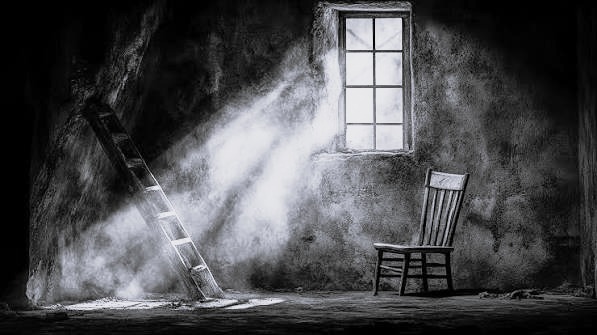
Broken windows, a shuttered room, flakes of white paint of multiple sizes dusting the wooden floor, swept by winds, dampened with rain and snow in autumn and winter, dried out and crumbled to dust in summer. This constellation of paint, brushed upon walls and ceilings more than half a century ago, lies as an audience for the old oaken rocking chair, shrouded in darkness, in the corner of the room, placed in a spot where sunlight shall never greet. It only moves when the storms are at their fiercest, which is rare in this town in the mountains, far from the shore.
Hurricanes and tropical storms never reach this part of Tennessee, the last range of the Cumberland Mountains east of Tullahoma, and the last tornado touched down nearly a decade before this house was built. There is no one left alive to remember its passing, though the event is recalled in photographs on display at the local historical museum.
The house never endured a major storm; only relatively mundane, normal weather events, such as summer thunderstorms and the annual winter blizzard. It did, however, offer homes to several families, the first of which—according to records kept at the historical museum—arrived in 1947, the year it was built, shortly after the Second World War. The house replaced a Craftsman-style structure built before the Great Depression, which had burned down the summer after the tornado.
The architect disdained modernity and built this new home in a similar style, adding archaic, though charming, Victorian touches such as ornate wooden frames and lattice above the front porch, and installing stained-glass windows in the first-floor parlor and dining room. The family that moved in tolerated the windows until they could afford to make changes in 1955, replacing the stained glass with more modern frames to accommodate an air conditioner in the parlor and more sunlight in the dining room.
That year, the eldest daughter discovered Elvis, hearing "Milkcow Blues Boogie" late one night after a sleepless night following a break-up with her boyfriend. The following day, she went into the local Woolworth’s on the corner of Park and Main and flipped through the 45 singles bins. She could not find the record, so she asked the clerk, a balding, bespectacled gentleman, his hair greased tightly high above his eyes in increasingly vain vanity.
He was older than her father, yet not by much.
“Do you have any records by Elvis Presley? I’m looking for the song Milkcow Blues Boogie.”
He looked at her with a judgmental stare, a gaze that chilled her still when she recalled it as a much older woman.
“That’s race music, miss.” However, without blinking, he pointed to a bin in the far corner of the music section. “You will find something of his there, I imagine.”
The record she was looking for was not there, but she found his latest offering, “I Forgot to Remember to Forget.” On the flip side was a song titled “Mystery Train.” She listened to the record, smoking a Fatima cigarette she had snuck from her father’s pack. She didn’t like the first song, but, as she told her grandchildren before her death, she played Mystery Train to death while staring out her window at the moon and stars after dinner and homework, imagining big doings in the world beyond and true love with hearts intertwined forever.
After high school, she packed her things and left for college, taking Mystery Train with her. She came back during school breaks and sat in her room, staring out into the night, as her imaginings of big doings evolved. Not necessarily her dreams becoming bigger, as it were, but more realistic, polished, becoming more apparently revealed as she learned more than from books. When she felt sad, she would go to her red paper-covered portable record player and play the single she bought at Woolworths, along with others from her growing record collection. She always kept the volume low enough to not disturb the family, so she sat at the window in her rocking chair, the one that had been in the family since her great-grandpa came back from the Shenandoah, with the record player balanced on the windowsill, listening to Elvis. As the years passed before graduation, Elvis Presley's voice became more distorted as the vinyl wore out from the heavy stylus with each rotation. But to the girl, now crossing the threshold to womanhood, hearing him remained for the first time ever.
Diploma in hand, she moved on to Knoxville and her first job. After a lateral move to a bank in Asheville, she met a man, got in trouble, and quickly married. He wasn’t such a bad guy, but after years passed, working in the bank, with two daughters, she packed up Elvis and the girls and left him. They stayed briefly, one last time, in the house, her mother and father distraught but understanding. The father withdrew a substantial part of his retirement savings from the bank and handed the money to her, pushing it on her when she refused.
Last night, after the girls fell asleep, she took the record player and placed it on the windowsill. She sat in the rocking chair in her old bathrobe, hair pulled back, smoking a Benson and Hedges, blowing cigarette smoke into the cloudless night, Mystery Train playing one last time as she conjured fragments of past dreams, sewing the unrelated segments together in a quilt.
They planned to leave the following morning for Texas, taking a job at a much larger bank, with her little sister promising to put them up until she could settle. When it came time to leave, she found she did not have enough room in the car to bring the rocking chair. Her mother, tears temporarily dried, smiled and put her hand on the back, pushing it back and forth.
“Don’t worry, sweetheart. That old chair is always going to be here for you.” They had one final hug, and the woman left without looking back.
She did, however, occasionally return to the rocking chair: Christmas in 1972 and 1974. Also, the girls came to stay for a month every summer from 1975 to 1979, taking the Greyhound bus from Texas to visit Grandma and Grandpa. However, at the end of these visits, the rocking chair remained in the upstairs bedroom.
In the winter of 1979, after a trip to Memphis, Grandma and Grandpa were killed in an accident involving a runaway tractor-trailer on Monteagle Mountain. Their daughters were indecisive about what to do about the house. After dividing the property, donating the bulk to the Salvation Army, and deciding to keep the house off the market and defer renting it, they hired a caretaker to maintain the property until they made a final decision.
After the last load of furniture was loaded, the eldest sat by the window in the remaining piece, the rocking chair, watching the Salvation Army truck pull away. She placed her hand on the window, sliding her fingers across where she used to place the record player. She had quit smoking several years before and felt the urge for one, but thought better of it.
“That ole chair is always going to be here for you,” she whispered, before rising and closing the bedroom door behind her.
The passing seasons added to the dozens. Despite the promised maintenance, the house slowly deteriorated, as did the surrounding neighborhood. By the end of the 1990s, the sisters decided to sell the house, and it was bought by a couple intending to use it as an investment. The new owners were charmed by the remaining Victorian touches, particularly the porch latticework. Before they could begin the necessary restoration work, they lost most of their intended budget when the dot.com bubble burst, and were forced to sell.
The purchasers were in the process of buying up the entire block to build an apartment complex and had only seen photographs of the house online on a real estate site. They never visited the property and went bankrupt a year after the sale.
The notation regarding the current ownership of the house is included in a description repeated across several databases, from the bank to the local tax authority. One only has to know the address to find it, but no one has since the elder daughter, curious, checked and called a cousin to stop into town and see what had happened to it. He took a photo of the house with his cell phone and wrote a long email. The elder daughter decided against visiting Tennessee and instead had flowers sent to her parents’ graves. She regretted not taking the rocking chair.
The copper wiring and plumbing were stripped out by meth heads, graffiti scrawled through most of the house, punctuated by multiple holes punched out in the walls. Sometimes, the interior reeks of the visits of vagrants and drug addicts. In the indeterminate future, once the condemnation proceedings are finalized and permits are issued, the bank will tear down the house and market the lot for commercial use.
Until then, the house stands, decaying.
Upstairs, the shuttered room with the antique rocking chair shrouded in darkness remains.
The story one hears in that part of the Cumberland is that no one goes into that room with the rocking chair.
As time passes, the story is layered with wild details—such as a ghost of a headless woman in the chair or hanging corpses in the closet—the kind of stories typically told about abandoned houses.
Truth be told, if you are daring and patient, and you hang around outside on a midsummer night, particularly at solstice, you’ll hear Elvis, sounding like the record on the turntable is very worn.
BIO: Mike Lee is an editor, writer, and photographer at a trade union in New York City. His fiction has appeared or is forthcoming at Blood+Honey, The Brussels Review, BULL, Literary Garage, Literally Stories, Mythic Picnic, Bristol Noir, The Airgonaut, and elsewhere. His story collection, The Northern Line, is available in many online booksellers.
Follow on Social
Literary Garage: Storytelling with grit, heart, and no off-ramp.
© 2025. All rights reserved.
Connect


editor@literarygarage.com
Follow us on Substack for updates and news
Clicking thE SUBSTACK link will direct you to an external website for our Substack feed. The content and privacy practices of Substack are not controlled, and no responsibility is taken for any issues that may arise on the platform.
Editor-In-Chief: Kevin Christopher Michaels
Special Features Editor and Warrior God: Michael Downing