
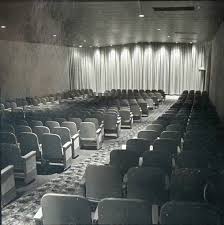
I worked as an usher with Tommy at the movie theater, ripping tickets, sweeping the floor, picking up sticky objects under seats.
Before work, we drank coffee at the diner. Tommy wanted to make a scary short film for his college thesis, no haunted house bullshit or monsters, he said, just psychological horror. It’s called The Commuter, he said. A guy goes back and forth on the train but never gets off, like a loop. Then at the end he walks away into a bright light, like he’s paying penance or something.
Penance for what?
That’s for the audience to decide. I’m going to edit in some weird stuff, flashbacks or something. It’s all style, black and white, cool angles.
That waitress over there was my first crush, fifth grade, I said. I wanted to marry her.
Ask her out, Tommy said.
She was the prom queen.
She’s a fucking waitress now, he said, there’s no more hierarchy. I spelled hierarchy. I like to spell muti-syllabic words, I said.
Tommy said a guy in his class was making a film about a loser going on a date. He wants me to help him with effects, Tommy said, fake snow blowing, the guy can’t get the convertible top up, shows up at the girl’s house frozen, she has to thaw him out. Superficial crap.
Sounds funny to me.
There’s no ambiguity, he said. I spelled it. The first big word I spelled was dilapidated, I said. Used it in a haunted house story.
I was never much of a speller, he said.
At the register we paid the check and I bought a newspaper for the theater owner. I looked back at the waitress, Donna. There was something anachronistic about her in this setting, far from the kickball field sunshine of fifth grade.
The movie theater sat at the corner of the shopping center. The owner’s office was cluttered with movie posters and stacks of folders. Movies are getting bloodier, he said. Harry wants to retire. Wants to know what happened to the old love stories. Any of you guys want to learn the projector?
I’m not very technical, I said. And my father needs me at his hardware store.
I just want to make movies, Tommy said.
I hope it’s not that kind of crap like they did in ’72, when Harry almost quit. That movie with the ad that said something like, keep repeating, it’s only a movie. Harry said it was the most disturbing thing he’d seen. Said just because it’s only a movie doesn’t mean it has to be the worst movie he’s ever seen.
Last House on the Left, I said. I was too young to see it.
I was in Korea, the owner said, saw some bad stuff, but there was something about that movie that almost made me sick. The things people do to people not in war.
The owner had a crew cut and chewed on his cigar. His office faced the rear of the shopping center, with a view of a dumpster. After the war, he said, he drove a cab, bartended, did some carpentry. He thought the world was too sad, he wanted to see people entertained, to escape from their lives for a little while, and movies seemed like the perfect solution.
Oh boy, he said, looking at the paper. Gig Young died.
Who’s Gig Young, Tommy said.
Jeez, the owner said, nobody knows their movie history.
He won the Oscar for They Shoot Horses, Don’t They? I said.
I’ll be a sonofabitch, he said. You know your movies. We need more young people who know about Hollywood.
I know James Dean, Tommy said.
Gig won the Oscar for supporting actor, I said. The movie is set at a dance marathon, during the Depression. This woman hates life and asks her dance partner to shoot her and when the police ask him why he did it he says, they shoot horses, don’t they?
The owner skimmed the article. Killed his wife, then shot himself, he said.
Gig was once married to the actress from Bewitched, I said.
Jesus, kid, you’re an encyclopedia. Yeah, maybe she cursed him, he laughed. Hell, he had a lot of wives. Maybe they all cursed him. That picture he won the Oscar for was the first one I showed here when I bought the theater. ‘69. And you know what’s funny, I fired the first usher I hired. Forgot to put the question mark on the marquee after the title. Even left out the comma, for crying out loud. Said he didn’t think it mattered. The owner put the paper down. Goes to show, he said, you don’t know people. Guy had an Oscar, fame, and bam. All gone.
I asked him if I could borrow the paper. He handed it to me. Gig looked like the type who woke up in a suit with a martini glass in one hand and a cigarette in the other.
New movie time, the owner said. Let’s get those tiles up.
Outside, I held the ladder while Tommy put up the letters. A horror movie called Halloween.
Better not forget the punctuation, I said.
For Halloween? he yelled.
I felt the ladder shake. Just kidding, I said.
It’s like a fucking English class, Tommy said.
The owner came out and put his hand on my shoulder. You sure know your movies, kid, he said. Boy, how do you like that Gig Young. Bam, gone.
My father was asleep in his chair, the paper in his lap. The TV was on, an old black and white western.
I had leftover meatloaf, washed the dishes, and sat on the couch, the same spot where my mother caressed my hair as we watched old movies together, saying it was so fine and golden it looked like Rumpelstiltskin had something to do with it. You could be a movie star with that hair, she said, then the whole world will love you.
Rumpel who, I said.
He’s from a fairy tale, she said. He’s like a little elf.
How do you spell it?
It’s not a real word, she said. You can’t spell it.
Lying in bed I thought about Gig Young’s Oscar. I wondered if it witnessed the killing.
The Friday night showing of Halloween was sold out.
After the movie I stopped by the owner’s office. Going to be a hit, he said. They like this sick stuff. Think about the projector, kid, you sure know your movies.
I cleaned up the lobby, torn tickets, candy wrappers. Outside I swept up cigarette butts.
I looked up at the marquee. Cracked and faded. Freaking Tommy, I said aloud. He left a letter out of Halloween. The owner thought Tommy was a clown and would probably fire him.
I parked on Blue Spruce, where Donna lived. It was the first street I knew the name of that wasn’t mine. On the kickball field I spelled multi-syllabic words for her and said the blue spruce was a tree that never lost its color. You’re smart, she said, and she held my hand and said we could be like the tree and always love each other. But a week later a new boy, Gary, showed up, hair down to his shoulders; someone said he had young parents who were hippies and Vietnam war protestors, and he charmed the hell out of Donna doing tricks with his bike.
I got jealous and wrote a dilapidated haunted house story where I had a monster rip Donna’s head off. I read it aloud to the class and she called me a weirdo. I retaliated with one of those forbidden single syllable words I’d just learned. Everyone knew about fuck and shit but cunt was a new one and sounded vicious, even though nobody knew what it was.
The next day, when I got to the theater, the marquee looked like a sloppy scrabble game. Crooked letters. The ladder was on its side. A police car sat at the curb.
Somebody try to steal our letters, I asked the officer. I work here.
I’m sorry, son, he said. The owner died. Was up on the ladder and fell.
I stared at the marquee. I didn’t know what to say. I sensed the officer was waiting for me to say something. The little things were important to him, I said. Like I was giving a eulogy.
The police car pulled away. A cigar stub lay on the sidewalk. I picked it up. I imagined the owner, chewed up cigar in his mouth, climbing the ladder, grumbling about how these goddamn kids couldn’t spell, reaching up to add the missing letter, reaching a little farther, overestimating his mobility, and then falling, grabbing at the titles like they were a lifeline.
I unlocked the theater. I placed the cigar butt on the opened newspaper in his office, on top of Gig’s photo. Both of them, bam, gone.
I sat in his chair. There was a small, framed picture behind a stack of papers. The owner standing in front of the theater pointing up to the marquee. Now Playing! was spelled out.
I put up the ladder and cleared off the remaining letters. The blank plastic facade looked like a forlorn artifact, the kind of remnant you’d find sitting atop a pile of debris after a bulldozer had done its job of leveling an obsolete structure.
Later, me, Harry, and Tommy stood next to the owner’s wife under the blank marquee. I lied and told Tommy the owner fell off the ladder trying to put Now Playing! above the title.
I told him to be careful whenever he went up on the ladder, she said, but he laughed and said if the Chinese and the Koreans couldn’t kill him, he could make it through the suburbs. She said she’d probably sell the theater; she’d have to talk to their accountant. There had been interest in turning it into a Thom McCann shoe store.
A fucking shoe store, Tommy said, when she was gone.
I was retiring anyway, Harry said. He shook our hands and went into the theater to pack up his personal items.
I don’t know anyone that died, Tommy said.
My mother died when I was 13, I said. Leukemia. A terrible sounding word.
You want to play my commuter, Tommy asked me.
He sounds older.
You wear an overcoat and one of those hats everyone wore in the 50s. There won’t be any close ups. What do you think.
Can we have a shot of my hair, I said, like it’s glowing, a halo.
Get a feel for being a commuter, he said.
I tried on one of my father’s old suits and then opened his unused briefcase with the metal clasps and put the newspaper with the Gig Young article inside along with my mother’s autopsy report. I came across the document in a shoebox in my father’s closet. A Thom McCann shoebox. The autopsy listed her disease as acute myelo-monocytic leukemia. It was quite the multi-syllabic word. I had no interest in spelling it.
I walked a few side streets over to Indian Head Road and then continued up to where the church was located. I used to work there as a custodian in high school, before I took a job at the theater. It’s like I traded in one kind of smell for another.
I entered the church through the side entrance. A woman was lighting a candle. I walked through the pews and turned into the center aisle, where brides and caskets made their journey. Years earlier my father and I walked behind my mother as the funeral director wheeled her up to the altar.
My shoes squeaked on the freshly waxed tile. The woman who lit a candle prayed in the pew. She looked at me. I shuffled over to her. I put my briefcase down.
Prayers don’t work, I said. There’s too much evil in the world.
Who are you? I’m getting the pastor.
I walked away, through the exit, and up the stairway to the Catholic school. I went into the girl’s bathroom. The worst part of the job was cleaning out the menstrual pads from the metal box on the floor next to the toilet. The first time I opened the box I was nervous, like when I’d turn over a rock as a kid and not know what kind of bug would slither out. The pads were bloody. Once, someone wrote ‘go to hell’ on the mirror in blood. Maybe puberty made them uncomfortable and they were sending a message to God or maybe it was meant for one of the nuns or a bullied student. I wondered if these girls were aware that a new round of blood would eventually be released when a boy’s cock entered them for the first time.
Walking the hall I browsed the drawings taped to the concrete walls. Jesus scenarios and family illustrations. Jesus was just a commuter himself, a kind person who roamed around caring for people, like my father, two carpenters, heroes of fixing things, and I imagined if my father was gone the neighborhood would suddenly implode, an apocalypse of collapsing structures once erected and assembled with precision, aluminum sheds, fences, gutters, tree houses, sink and toilet repairs, now a cacophony of screeching and shattering and splintering of porcelain and building materials.
I laughed out loud thinking about it and the sound echoed in the empty hallway.
A teacher looked out from a classroom, a young woman holding a small paint brush, the art teacher, I guessed, and she asked if she could help me, the drawings are happy, I said, but once I saw something in the bathroom that wasn’t very nice so maybe they’re painting what you want them to and not what’s really inside them.
She said she was going to call Sister Kathleen because she didn’t think I was a parent and was trespassing and I said it can’t be trespassing because there are no trespassers in Jesus’s world. We’re all welcome.
I walked along the strip malls and gas stations, as if for the first time, and in a way it did feel like the first time, seeing the town on foot, not on my bike or in the car, noticing little things, like a forlorn beauty in the way the weeds looped up through cracks in the sidewalks and asphalt.
I looked across the street to where the movie theater sat nestled in a corner of the shopping center, a small rectangular brick building with a blank white marquee that once spelled out everything from Disney to James Bond to sickening horror.
What did the owner say, if the war didn’t get him he could make it through the suburbs. He could’ve waited and asked one of us to get out the ladder but that’s what men of a different era did, like Jesus or my father, take it upon themselves to fix something.
The diner was about a hundred yards away, a dot of light in the distance on the darkening turnpike. I thought of the story we read during my brief time in college by Hemingway about the well-lighted café, and how the diner was the suburban version of it, the place my parents came after church and my mother talked of kids in the neighborhood who got caught stealing in the toy store or smoking, the kinds of kids she called bad apples.
Donna poured coffee, in a white outfit that stopped just above the knee. I’d never see her legs again like I did in school, when she wore fashionable hot pants, stopping at the top of the thigh. There’d also been a quick view of her tiny pink nipple when she did a cartwheel on the field and her top went up, my first and only view of the female anatomy, while she progressed to popularity and boyfriends and I masturbated to Playboy, women who looked back at me with the kind of smile that could betray you in a second.
I sat at a table she was wiping off. It’s me, Henry, I said, from fifth grade.
Hi, she said. Fifth grade? Didn’t we graduate together.
Fifth grade was really the last time you saw me, I said. Remember when I spelled dilapidated. That was the first thing I ever said to you.
I remember you were a good speller.
How about my haunted house story?
Wasn’t it kind of bloody, she said. Everyone thought you were a little strange after that, maybe in a good way, I don’t know, like you had a talent for writing scary stuff.
It didn’t sound like she remembered having her head ripped off or being called a bad word. I laughed and said, now I’ve got a talent for sweeping up the movie theater when people come to watch scary stuff.
Look at me, she said, I’m wearing a name tag. Hard to find a job in my area. Horticulture.
I spelled it. See, I can spell it, I said, but I don’t know what it is.
She said our town was named after the Indian translation for fertile or pleasant land and it got her thinking about nature and the environment so she wanted to study something that had to do with plants and flowers and gardens.
I don’t know how pleasant the land is, I said. My mother died of cancer. I opened the briefcase and took out the autopsy report. I said, her life was reduced to this clinical jargon. Look at these words. I pointed to something called hepatosplenomegaly. How do they come up with these names, I said, and after she died the neighbors blamed it on those pesticides the potato farmers used before the suburbs, all those goddamn pesticides they said, and the town dumps with mountains of junk, that can’t be good for the land, piles of metal and plastic and rubber from TV sets and refrigerators and washing machines, that stuff’ll outlast us, all those cancer causing chemicals, rusting and decomposing. So I don’t know how pleasant the land is anymore. Maybe we can protest that. Like everyone protested the Vietnam War.
Interesting idea, she said. Do you want to order anything?
Just coffee.
I looked at the newspaper, Gig Young smiling, holding up his Oscar, a few pages away from an ad for Halloween, a pumpkin and a knife, bookends on a theater owner’s life.
She came back and filled my cup.
Do you remember us talking about your street, Blue Spruce, I said, and how we would always love each other.
Sorry, I think that was with Gary, she said. All the girls liked him.
I finished the coffee and looked around. It wasn’t a clean, well-lighted place anymore, only despair, nada, the word Hemingway used, nada, nothing, an empty cup.
I’m commuting, I said. My mother said when I become a movie star the whole world will love me.
I unlocked the theater. The stale smell of popcorn wouldn’t linger for much longer. I sat in the owner’s chair. I picked up the cigar stub, found a match, and got it glowing.
You sure know your movies was the last thing he said to me. It was a shame his last movie had to be about unstoppable evil, not one of Harry’s love stories. A poster for Halloween was rolled up in the corner. I touched the cigar tip to a corner and watched it curl. I carried the burning poster into the theater and placed it under the velvet curtain. I went back to the office and lit up another poster. I stuck it between a stack of folders.
From across the street, I watched smoke rise through the roof.
I walked over to Blue Spruce and made my way across lawns, through shrubs, and felt the needles of a blue spruce tree poke my face. I sat on Donna’s stoop and watched kids play kick the can in the street beneath the light of the streetlamps, until Donna came home and sat next to me, her hand in mine, and I spelled words, dilapidated, leukemia, Rumpelstiltskin, still content in never getting it right, the yellow gleam from her porch light casting us in a nostalgic glow. Oh, she said, your hair is like a halo.
I left Blue Spruce for the last time, my hands sticky with something, sap from the trees, or something else, I couldn’t see in the dark.
At church I lit a candle. The flame swayed, a graceful belly dancer in slow motion, not like the savage unrestrained fire at the theater.
I sat in the pew and thought how Donna was just a prom queen who smelled like western omelets, and I laughed, a maniacal laugh, and then I spelled it for the whole world to hear.
BIO Peter DeMarco is a retired New York City high school English and film teacher. Before teaching, Peter spent a considerable amount of time acting in regional theater and attempting to be funny on the stand-up comedy amateur circuit. Once upon a time he was nominated for a Pushcart. His writing has appeared in The New York Times “Modern Love,” New World Writing, trampset, Maudlin House, A Thin Slice of Anxiety, Bottle Rocket, BULL, Hawkeye, Does It Have Pockets (Best Microfiction nominee), Pithead Chapel. Read more at: peterdemarcowriter.com. Twitter: PDMwriter
Blue Spruce
by Peter DeMarco
5/22/2026
Blue Spruce
STORIES
By Peter DeMarco
5/22/2026
Follow on Social
Literary Garage: Storytelling with grit, heart, and no off-ramp.
© 2025. All rights reserved.
Connect

editor@literarygarage.com
Follow us on Substack for updates and news
Clicking thE SUBSTACK link will direct you to an external website for our Substack feed. The content and privacy practices of Substack are not controlled, and no responsibility is taken for any issues that may arise on the platform.
Editor-In-Chief: Kevin Christopher Michaels
Special Features Editor and Warrior God: Michael Downing