
Always On Paper
STORIES
By David Hagerty
3/13/2026
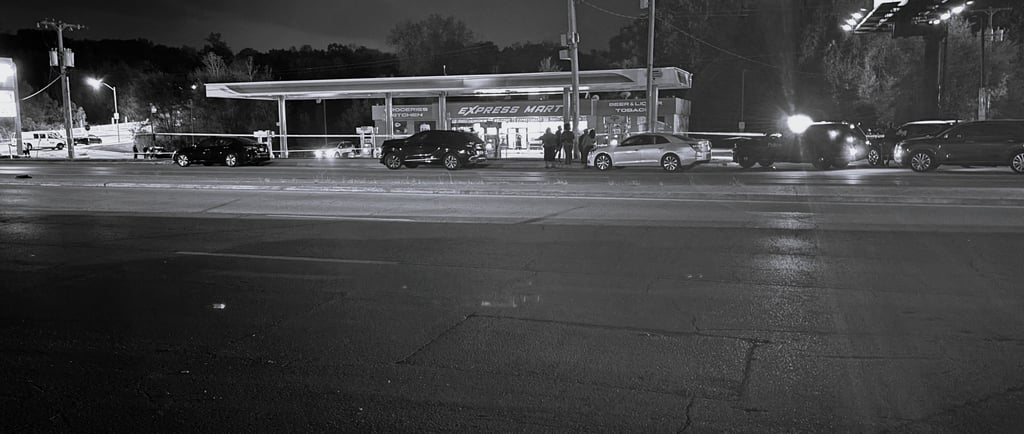
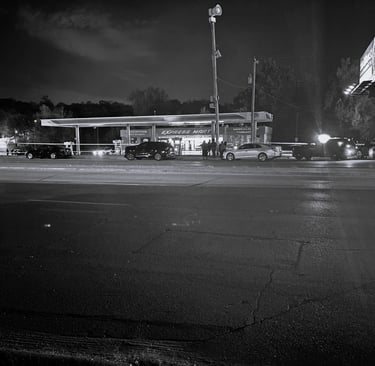
The paramedic pushed back my hair and held my head still while he pressed gauze to my forehead as if I was a boxer being patched up between rounds. Still, disinfectant dripped into my eye, stinging worse than my wound. Twenty feet away, cars blurred by on the freeway, and trucks rumbled past. Even sitting on a metal guardrail in the dim light of the parking lot, the swirling emergency lights made my head throb. Meanwhile, a dry, cool wind blew across the flat plain of California’s Central Valley, carrying grit from the farmlands and an ammonia odor of fertilizer.
Once the medic had tacked on a bandaged, two patrolmen surrounded me. They stared at the name badge on my chest as if it was a prison number. In their eyes, my uniform from the Speed-e-stop convenience store dead ahead defined me.
“You’re Dinkins?” asked one cop, who had a fleshy baby face and a teenager’s gangly body, the uniform loose in his narrow shoulders.
I nodded, although it hurt my head to move it.
“The night manager?”
Again, I nodded, causing my head to swirl.
As the medics packed their bags, the younger cop removed a small notebook from his breast pocket and clicked open a fountain pen as if it was a syringe. “Can you tell me what happened?”
“What happened is I got robbed.”
“By who?”
“Two guys with guns.”
“Did you see either of them?
“Not through their ski masks.”
“Could you discern their race?”
“Like I said, not through their masks.”
“Height, weight, age?”
“You ever had a gun stuck in your face?”
The first cop glanced at the second, who was older, grizzled, with a veteran’s hard glare. He could have been my stern father, with thick forearms and weathered skin. Still, he allowed his younger partner to do the talking. “Thankfully not.”
“If you had, you’d know the only thing you’re thinking about is not getting shot.”
“I understand it’s upsetting to rehash a crime so soon after it happens, but anything you tell us about the robbers will help in apprehending them.”
“You’re not going to catch them.”
“Why’s that?”
“They had this dialed in: picked out the place, showed up at night, waited till I was alone, pretended to buy something so I’d open the till, grabbed what they could, then got away fast on the freeway.”
I pointed behind me, where cars streaked past, leaving a trail of headlights, exhaust, and engine noise. The medics interrupted to ask if I wanted a lift to the hospital. I refused.
“You sure you don’t want to get checked out?” one medic asked.
“Can’t afford it.”
They had me sign a form declining treatment while the two cops clocked me. Then the ambulance rolled away with just a crunch of gravel—crisis closed.
“How much did they get?” the first cop asked.
“Whatever was in the drawer.”
“About how much was that?”
“A hundred, a thousand. What’s it matter? It’s gone.”
“The owner will want to know so he can claim it as a loss.”
“He makes plenty off this place.”
“How much in a typical night?”
“More than I’ll ever see. We got people coming in all hours for booze, smokes, condoms. You’d think nobody in this town ever slept.”
The first cop nodded with mock empathy while the second just stared with the judgement of a parent disappointed by his low-rent son. “Still, that business keeps you in a job.”
“A shit job that nearly got me killed.”
“There’s no cause to be defensive, sir. I’m only trying to ascertain what happened.”
“And I’m telling you.”
Before he could ask more, an old black Lincoln Town Car stopped a dozen feet off. Its long hood and gleaming paint looked as out of place in the store’s parking lot as a whale on land. Out flopped my boss, Mr. Wilkins, his fleshy body wrapped in a bathrobe, his round head nearly bald. He waddled straight to us and started shouting, “How much did they get?”
The second cop led him away by the elbow while the first stuck with me.
“Why did they hit you?” the first cop said.
“Why? Because that’s what robbers do.”
“Did you resist?”
“No.”
“Was it with a fist, a club?”
“The gun butt, I think.”
“You think . . . .”
“I’m not for sure. Like I said, if you ever had a gun pointed at you . . . .”
“Were they standing in front of you, behind?”
“In front, across the counter.” I swung my arm as though to strike the cop but stopped just short.
“And you didn’t fight back”
“With what, a lighter?”
“Some stores keep a weapon under the counter.”
“He’s too cheap.” I pointed toward the owner, who was flailing around as if he’d been robbed instead of me. Probably upset I got him out of bed. He rarely showed for the night shift.
“Why didn’t you fight back?”
“Isn’t that what you guys always tell people: don’t resist.”
“Except in self-defense.”
I stared at that cop, who probably grew up on a farm in the valley, enrolled in the police academy straight out of high school, and learned everything he knew about crime there.
“If I’d tried to fight back, I’d’a been shot, not hit.”
The cop’s partner returned and spoke to me for the first time. “You drive to work?”
“No other way to get here.”
“You have a license?”
“You think I’d drive without one?”
He glared as if he wanted to hit me, too. “I need to see it for our report.”
I yanked out my wallet and handed over my ID to the second cop, who examined it with his flashlight as if he doubted its authenticity. Then he walked back toward the owner while speaking into a mic strapped to his shoulder lapel. Through the first cop’s crackly radio, I heard the second ask a dispatcher to run my ID number.
“You said they stole all the money in the till,” the first cop said.
“Everything they could get.”
“But not your wallet.”
“I’ve only got but five dollars.”
“They didn’t ask you for it?”
“Wouldn’t’ve asked. Would’ve just taken it.”
“But they didn’t.”
“Probably knew it wasn’t worth the trouble.”
“But they wouldn’t know that without looking first.”
A semi blasted its air horn on the freeway, making me flinch as the sound reverberated through my headspace.
“I’m not thinking straight,” I said.
“Why do you think they left your money?”
“How would I know? I’m no robber.”
The cop jotted something in his notebook.
“What are you writing?”
“Just what you said.”
I tried to read his script, but the cop angled the little black book so I couldn’t see it.
“Did you observe the robbers exit the parking lot?” the cop asked.
“Through the blood in my eye.”
“What kind of car were they driving?”
“Hatchback.”
“Make, model, color?”
“I couldn’t tell. It was dark.”
“Which way did they go?”
I pointed north.
The cop walked to where his partner was standing with the owner and talked to both of them on the down low. Neither uni looked at me, but the owner stared as if I’d committed the 211. Typical for the man to blame his employees any time the store lost money. He’d take it out of our pay if the daily count came up short, claim we were stealing from him. Tight bastard.
As the young cop returned, I stood to test my balance. It felt straight enough to drive.
“I have a few more questions,” the cop said.
“About why I didn’t fight off two men with guns using my bare hands?”
“Please, sir, sit.” He gestured to the sharp metal barricade, which had left a numb spot in my leg. Still, I complied.
“Why did you use a false name at work?”
“Say what?”
“Your name badge,” he tapped my chest with his pen, “is different from your license. Why do you use multiple names?”
Without thinking, I touched my head again as if I was concentrating and came away with a spot of blood from the bandage. Why did I give the cops my license? After two years of practice, I should have dodged that question, but the beaning had broken down my usual defenses.
“Because he pays me under the table. Said we’d both owe less taxes that way.”
“So you’re not paying any taxes?”
“On everything I buy.”
“But not on your income.”
“I don’t decide how much he takes out of my check.” I pointed to the owner, who pointed back at me. I couldn’t hear the specifics of what he said over the traffic noise, only a few words, like “again” and “liar.”
“That’s why you gave him a false name?”
“He doesn’t care who I am. Only that I make him money.”
The cop scratched some more in his notebook. Meanwhile, the owner and the second uni walked from the parking lot to the store. Probably cold, what with the night winds cutting across the fields. Of course, nobody worried about a clerk like me sitting out on a guardrail.
“You work alone?”
“Every night.”
“Why is that?”
“Owner is too cheap to pay two people.”
“It would be safer with two.”
“Tell him.”
“We will, but I want you to think on it as well.”
“Nothing anybody else could’ve done.”
“Still, you’d have another witness.”
“What good’s a witness do?”
“It would help us establish what happened.”
“Watch the tape.” I nodded toward the store, which kept security cameras, more to make sure we weren’t stealing than to catch the customers who were.
“We will.”
A dented and rusted-out Camero skidded to a halt on the lot. When a skinny, teenaged girl with stringy hair stepped out of the passenger side, I yelled “We’re closed” even though the volume hurt my head. The girl flipped me off before climbing back into her ride and peeling out.
“So why again do you use a false name at work?”
“I don’t want the people here knowing who I am.”
“Have you been involved in a robbery before?”
“Why’d you ask me that?”
“Please, sir, just answer the question.”
I needed to think, but my mind wouldn’t work. I swigged from a bottle of OJ that the paramedics had taken from the store to boost my blood sugar, but it tasted acid.
“Once, a while back.”
“When, specifically?”
“I don’t remember.”
“What about roughly?”
“Can I get back my license? I want to go home. I’ve got a wicked headache.” I pointed to the bandage again as if it weren’t obvious.
“Once we’re done here.”
“How soon’ll that be?”
“As soon as you answer my questions.”
For a youngster, the cop showed a lot of game, keeping me pinned to that guard rail as if we were on a prison yard.
“About ten years back.”
“And where was it?”
“Out of state.”
“Specifically.”
“Chicago.”
“And what was your role?”
“My role? What, like in a TV show? I played tall guy number three.”
“I mean were you a witness, a victim, a perpetrator?”
“Why ask me that?”
“For my report.” He gestured to his notebook.
“A bystander.”
“Meaning you witnessed it.”
“Something like that.”
“Why were you convicted of robbery, then?”
It’s the head hit that made me susceptible. Normally, I wouldn’t be so free with cops. I sensed something off when they asked for my license, but I was too fogged to resist. Could they interrogate a guy with a concussion? Better not to test the question in court.
“What now?”
“You have a prior conviction for armed robbery in the state of Illinois. You want to tell me what happened?”
“If you know my history, then you know what happened.”
“The charges, not the details.”
“I was young and dumb.”
“And robbed someone?”
“My buddy did.”
“But you were charged.”
“As an accessory.”
“Who did you rob?”
“He robbed a store.”
“One like this?” He nodded to the Speed-e-stop, which looked bright and warm. The owner and the second cop were sitting inside, watching the video as if they were enjoying a movie, while I sat out in the wind and the cold, dirt pelting me in the face like the cop and his questions.
“Something like that.”
“And someone was hurt.”
“By my buddy.”
“But you were convicted of the robbery.”
“For not turning him in.”
“You protected your crime partner?”
“We weren’t partners. He never even told me what he had planned, just ran out of the store waiving some money and a gun.”
“So you drove the getaway car.”
“Not even. He drove.”
“But you were convicted.”
“For being there.”
“Is that what’s happening here? You’re protecting the robbers?”
“Why would I protect somebody that pistol whipped me?”
Because of the inmate ethic against snitching. Truth is, I’d seen enough of them to give the police a spot-on description. The one with the gun was pale, blonde, younger than the first cop, with bad skin, bad teeth, and bad breath. That I could clock even under the mask. The other one was scrawny, nervous, wired, with a tattoo on his knuckles: For Life. Tweakers, most likely, looking to score. But I wasn’t about to send two more mopes to prison—even if they deserved it.
“How long have you worked here?”
“A couple years.”
“And in two years, you never told the owner your true name?”
“Never needed to.”
“You don’t think he has a right to know who works for him?”
I hadn’t told anybody. Not my boss or my landlord or even my girlfriend. Nobody knew about my past, and I’d planned to keep it that way. Except this robbery would blow my whole new life to dust, like one of those fields stripped down to hardpan by the winds that blew through the valley. I’d have to start over in some other state, ditch everything I’d built, create a new name. I’d planned to get a better job, as daytime manager of a better store, one selling shoes or clothes or tools, whatever didn’t attract stoned teens with their own fake IDs, acting superior to the guy behind the counter.
But this cop wouldn’t understand any of that. The gold band on his ring finger told me he’d probably married his high school sweetheart as soon as she was legal and settled into a nice, middle-class life, counting the years till he could retire.
“Like I said, my boss only cares about how much money I make him.”
“Why would you choose to work in a place like this with your record?”
“What other job can I get with a record?”
“It wasn’t one of your parole conditions to stay away from convenience stores?”
“I’m done with parole.”
I flicked my hands to dispatch all his intrusive questions.
“What brought you to California?”
“Wanted to start over.”
“No friends, family?”
“Nobody I’d call that.”
“So as soon as you completed your sentence, you moved here.”
“Don’t make it sound so quick. That case was ten years back. I did five inside, three more on parole, been clean ever since.”
“But if you’ve worked here two years, you must have left right after.”
“No law against that. I wasn’t on papers anymore.”
“Still, you’d be in a better spot now if you’d kept to those parole conditions.”
“Like what?”
“Obtaining legal employment, disclosing your past convictions.”
“Never would’ve got a job if I did that.”
The owner walked out of the store, waving around some file of papers like a football coach outraged at a ref who’d missed a call. Meanwhile, the second cop spoke into the mic on his shoulder, causing the first one’s radio to crackle. He turned it down, then leaned into it so I couldn’t ear hustle the message.
“You’d also be in a better spot if you’d told the owner your true name.”
“How’s that?”
“So he wouldn’t suspect you of being complicit.”
“What, he thinks I robbed my own store and hit myself in the head for show?”
“I’ve heard of stranger crimes.”
“Well, I didn’t. Watch the video.”
“We have. It’s not enough to clear you.”
“Doesn’t make me—what’s your word?—complicit either.”
“But with your record, you understand why you’d come under suspicion . . . .”
“Because the law don’t believe in second chances.”
“The best predictor of future behavior—”
Rather than listen to him quote some police training manual, I stood to leave, but my head swirled. “I need to see a doctor.”
“As soon as we’re done.”
“When’ll you give back my license?”
“Once you’re truthful.”
“I told you everything I know.”
“You’ve withheld a number of things that are relevant.”
“Like what?”
“Your name, your history.”
“I’m the victim here.” I touched my head, which was bleeding again, leaving a tacky mess on my fingers, and showed the cop my stained hand. Was this my past catching up to me? Years ago, as a dumb teen, I’d kept quiet after somebody I knew played at being a robber. I thought I’d paid that debt in prison. Two years on the night shift should have satisfied it, but like with a payday lender, the bill kept growing. Maybe this was the final interest.
“But you haven’t been fully truthful.”
“Because the law never forgives. According to it, I’ll always be an accessory to an armed robbery, even though I had nothing to do with it.”
“If you hadn’t tried to hide—”
“I’d still be living that old life. Now you all are trying to take away everything I’ve worked for: job, apartment, freedom.”
“Only if you withhold evidence.”
“What, from him?” I pointed at the owner, not caring if he saw. “You should prosecute him.”
“He’s done nothing wrong.”
“Except cheat his workers and the government out of their money.”
“That’s not part of our jurisdiction.”
“Then go chase after the robbers.”
Another car slow rolled past the scene, ogling us. I wished I could climb in with them and motor away, but they never even stopped. I should have taken a ride with the medics. I could have been sitting in the ER mellowing on some good drugs instead of getting sucker punched by the cops.
“You said they left in a hatchback, heading north.”
“So you heard something I said.”
“We didn’t see anyone like you described as we drove in.”
“Cause it took you so long to get here.”
“Only eight minutes, which means we should have seen a vehicle driving the other way before it reached the next exit.”
“How would you know it was them? It’s too dark. All you can see is headlights.” I flung my arm to the freeway behind us.
“Which tell us speed of travel.”
“Out here, everybody speeds.”
“But you’re sure they fled in that direction?” He pointed as though it needed explaining.
“That’s what I thought . . . .”
“You’re not sure now?”
I put my hand to my head and tried to think.
I’d survived five years in medium security by keeping quiet and to myself. Along the way, I’d learned survival skills, like how to differentiate players from profilers, when to fight and when to front. I’d met enough violent men to develop radar for them, so when the robbers strolled in acting casual, I clocked them straight off and hid my wallet under the counter, guessing what was coming. I figured they’d be rushed enough that when I claimed I’d left my money in my car, they’d give. All to protect my worthless ID, which only earned me a gash on the head and an interrogation.
“I told you, I only remember getting a gun stuck in my face, then hit in the head.”
The second cop called away the first for a side conference out of earshot. I breathed in the cold night air and tried to tap into the detached state that got me through five years in lockup. It was elusive, though, hard to translate to the outs.
Once the cops finally returned, the first acted different, with more swagger. “Turn around.”
“Why?”
“The owner wants to press charges.”
“For what, giving up his money?”
“Fraud for now.”
“How’s getting robbed make me a fraud?”
“Because you falsified your W9.”
“You’re hooking me up for that because you can’t for the robbery. Because I got convicted before. Once a convict, always a convict.”
“You can’t lie on government papers.”
As the cop cuffed my wrists so tight it pained my head, I thought of all the missteps that led me to this barren parking lot by a barren field outside a barren town, but I couldn’t see any path that would have led me any place else. Once you’re on papers, all paths lead back to prison.
BIO: David Hagerty spent seven years working with inmates in a county jail. Since then, he has published more than fifty short stories online and in print, mostly crime and noir fiction. He is also the author of the Duncan Cochran mystery series, about crime and dirty politics in his native Chicago. Read more of his work at: https://davidhagerty.net/.
Follow on Social
Literary Garage: Storytelling with grit, heart, and no off-ramp.
© 2025. All rights reserved.
Connect
editor@literarygarage.com
Follow us on Substack for updates and news
Clicking thE SUBSTACK link will direct you to an external website for our Substack feed. The content and privacy practices of Substack are not controlled, and no responsibility is taken for any issues that may arise on the platform.